

Equip B2B Leaders to Build Elite, Future-Fit Sales Teams with Long-Term Revenue Impact
🚨 The Hidden Cost of a Sales Mis-Hire
A few years ago, a global CRO I worked with shared this story:
“We hired a ‘rockstar’ rep from a big competitor. On paper, they were perfect. But six months in, they hadn’t closed a single deal. Why? Their approach clashed with our culture, sales cycle, and customers. We wasted £100,000 and lost a key account.”
This isn’t rare. According to Harvard Business Review, 50% of sales hires fail within 18 months. That’s not just costly—it’s disruptive.
Mis-hires are not just a recruitment cost. They can lead to a financial loss of 30% or more of the first-year earnings, disrupt the sales pipeline, demoralise teams, and even jeopardise customer trust.
The question is: Why do so many smart B2B leaders still get hiring wrong?

Traditional hiring methods are fraught with risk.
It’s time to adopt a more structured and data-driven approach to mitigate these risks.
Most companies rely on intuition, unstructured interviews, and impressive CVs. Yet:
- 92% of sales hiring is still “gut-feel” based, not hard data (Objective Management Group)
- 20% + of new hires fail during onboarding (Sales Benchmark Index)
- Top performers are four times more productive than average representatives (McKinsey), yet we do not invest adequately in the success metrics of top performance.
Here’s the problem: past success doesn’t predict future success; each sales environment is unique. The risk of failure increases when hiring methods haven’t evolved to match today’s hybrid, AI-enabled buyers and more complex, protracted buying cycles.
✅ What Future-Fit Sales Hiring Looks Like
Let’s shift the lens. Great sales hiring starts long before the interviews begin.
Here are five essentials to eliminate risk and build elite, revenue-driving teams:
1. Define Success in Your Context
What works in one company may fail in another. You need clarity on what “great” looks like in your environment, such as sales cycle length, deal complexity, and the personas of decision-makers.
2. Assess Drive, Coachability & Adaptability
Forget the pedigree. Focus on potential. The best reps today are coachable, resilient, and able to thrive in uncertainty. Are your recruitment methods robust enough to assess these success traits?
3. Screen for Culture, Collaboration & Curiosity
Sales is a team sport. Sales representatives who align with your values, collaborate across departments, and stay curious about customers tend to succeed for longer. It is important to screen for cultural fit factors.
4. Tap into Passive Talent Pools
Top salespeople aren’t actively applying—they’re performing. To attract them, your employer brand and recruiter approach must sell the opportunity. Note: Top salespeople will not wait three months in a protracted recruitment process.
5. Onboard Like Your Revenue Depends on It
Because it does, companies with structured onboarding see 82% higher retention (Brandon Hall Group). It’s not an admin exercise—it’s your first step to quota success.
“Hiring isn’t about who can sell—it’s about who will thrive in your system, culture, and customer’s journey.”

🔍 Data Over Gut Feel: The Case for Assessment Data-Led Hiring Process
At Scale Your Sales, we call it SCALE —the data-informed process, a structured, research-based approach to evaluating candidates, not their CVs or resumes.
It replaces bias with insight and guesswork with evidence. Using this approach, clients have:
- Reduced ramp-up time by 30%
- Increased team productivity and culture fit
- Saved £100,000+ annually per bad hire
Example: A UK tech scale-up used SCALE Data Foundations to hire three new reps. Instead of picking based on charisma, they evaluated coachability, motivation, and fit. Achieved the three-hit quota within 5 months and stayed beyond 18 months.
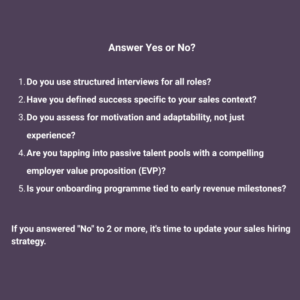
🧩 Your Hiring Checklist: Are You Future-Fit?
Use this quick self-assessment:
Question Yes / No
Recruiters typically charge between 15% and 30% of the candidate’s first-year salary, depending on their seniority. Recruiters that offer a placement guarantee of 60-90 days; however, CSO Insights reports that 75% of B2B deals take a minimum of 4 months to complete.
How is this equitable?
Let’s address a hot topic—AI in recruitment.
🤖 The Role of AI in Sales Hiring
Current use of AI tools in recruitment:
- Analyse language and patterns in CVs/resumes.
- Score assessments for motivation and logic.
- Automate scheduling and first-stage screening.
Myth: “AI will replace human judgment.”
🔍 Reality: AI is a tool, not a decision-maker. It can help reduce bias and surface patterns, thereby streamlining the shortlist. However, AI must be paired with human insight and structured interviews.
The question is: if we use more AI in recruitment, why is the fee % the same?

🧠 What Elite Companies Do Differently
They understand that hiring is not a transactional task—it’s a strategic revenue generator and an integral part of their growth plan. They:
- Invest in sales-specific, predictive assessment-first hiring
- Continuously refine your success criteria
- Prioritise onboarding and coaching
- Create a feedback loop between hiring and sales performance
They build resilient teams that sell better, stay longer, and grow faster.
📥 Your Next Step
Want to de-risk your next sales hire?
👉 Book a discovery call to explore the data-led approach.
👉Follow me for more tips on customer-centric growth and building productive revenue operations.
Let’s make your revenue operation future-fit.
#saleshiring #salesleadership #B2Bsales #revenuegrowth #AIinrecruitment #futurefitsales #ScaleYourSales
